Three people sitting on a bench facing a calm lake with mountains in the distance at sunset, framed by two leafy trees, while others sit or walk nearby on the lakeside promenade.

Because your treatment shouldn’t be a guess

Getting better shouldn’t feel like an endless search for what might work.

MeRT is the first and only FDA-cleared EEG-guided neuromodulation system for PTSD.

Who is MeRT for?

Whether you’re looking for an alternative to medication, searching for a more personalized approach, or exploring treatment options after other therapies haven’t delivered the results you hoped for, MeRT offers a different path forward for adult patients suffering from PTSD.
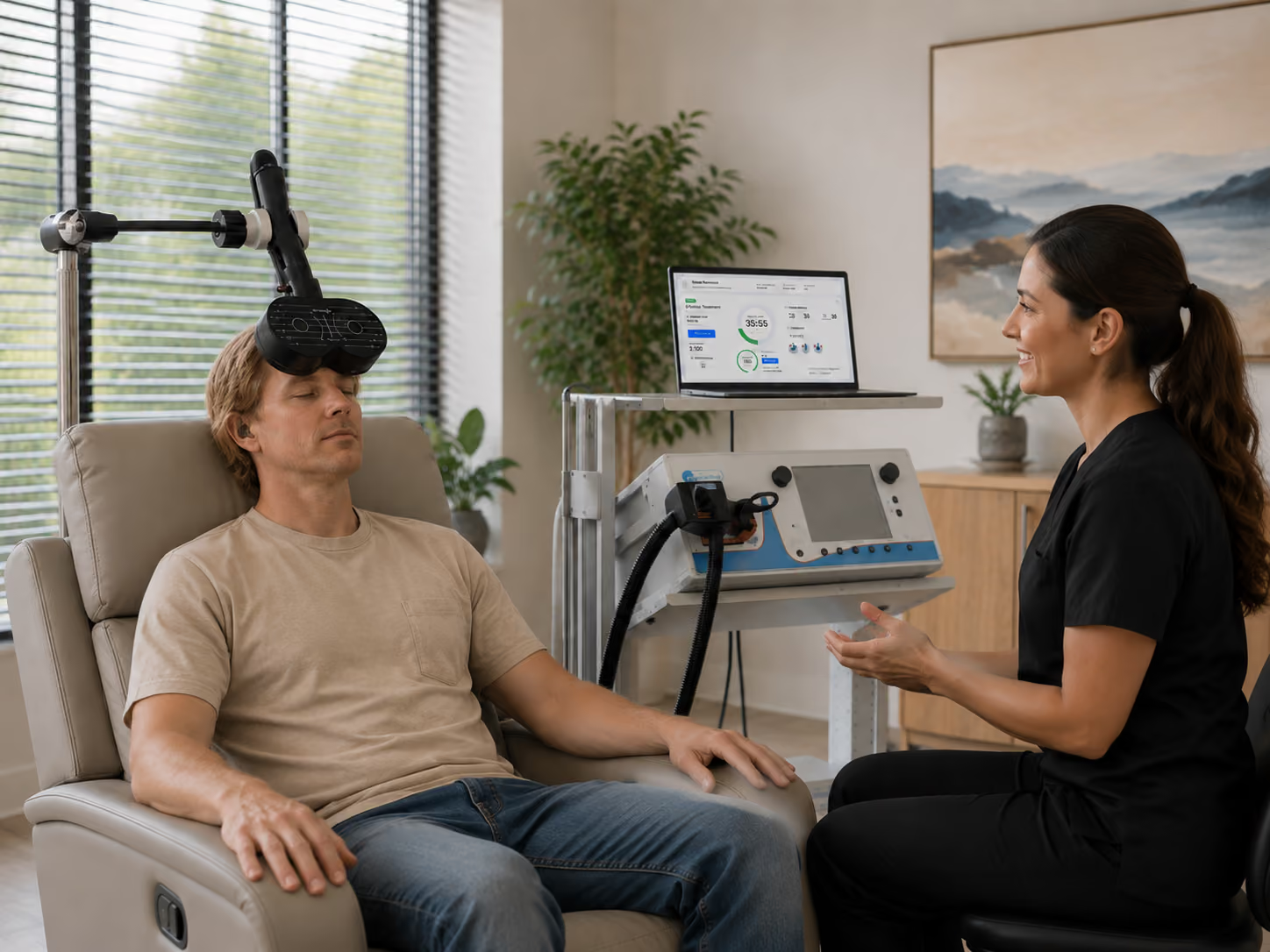
Man with eyes closed in a recliner receiving a brain stimulation session while a clinician in black scrubs sits beside him, with a treatment device and laptop in the background.

How does MeRT help?

Using insights from your EEG, MeRT personalizes treatment to your unique patterns of brain activity.
Through gentle, non-invasive magnetic stimulation, MeRT is designed to support healthier brain function. The goal is not simply to address symptoms, but to treat the underlying brain activity that may be contributing to them.

In as little as 2-6 weeks, patients receiving MeRT for PTSD have reported experiencing:

  • Enhanced mood
  • Better sleep
  • Increased focus
  • Improved relationships
  • More resilience
  • Better daily function 
*Individual results may vary. Contact your provider for more details about how MeRT can benefit you.

MeRT is more effective for PTSD than other treatments

Reported symptom reduction across PTSD treatment approaches. Outcomes reported in separate studies using the PCL-5 clinical scale.
Average Improvement
(PCL-5 symptom reduction)
TREATMENT
11.6-13%
Antidepressants1
23.5-33.3%
Trauma Focused Talk Therapy (CBT, CPT)2
30-40%
Other FDA-cleared 
Neuromodulation Devices3
52%
MeRT Pivotal Trial4
(1) Shiner et al., JAMA Psychiatry, 2020; (2) McGeary et al., JAMA Psychiatry, 2022. (3) Watts BV, et al. J Clin Psychiatry.2013;7(6):e541–e550.  
(4) Berlow et al. Brain Stimul. 2026. PMID 41241259. (5) FDA K260402 Randomized Controlled Trial, 2026.

Process overview

Step 1

EEG

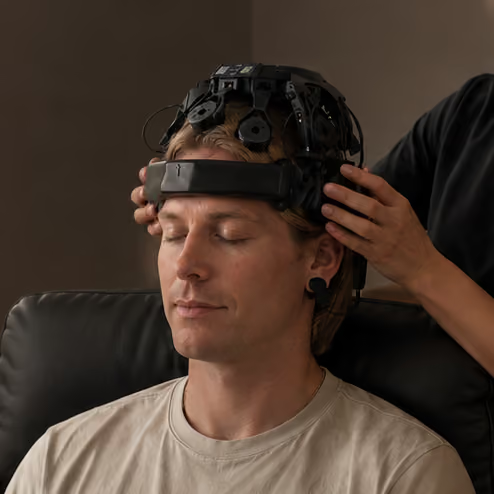
Man sitting with eyes closed wearing a black EEG headset while another person adjusts it on his head.
MeRT starts with an electroencephalogram (EEG) assessment of your brain's activity. It’s a quick, non-invasive brain wave scan done in less than 10 minutes – that measures your brain's unique baseline and activity patterns.
Step 2

TMS

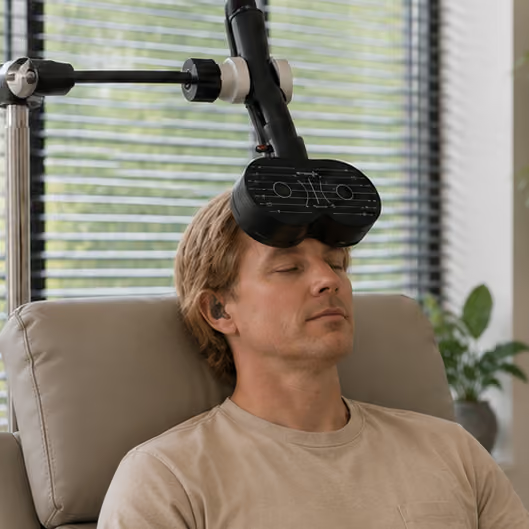
Blond man with closed eyes sitting in a beige recliner while a black device with multiple sensors is positioned on his forehead, attached to a mechanical arm in a room with window blinds and a green plant in the background.
Those insights are then used to personalize Transcranial Magnetic Stimulation (TMS), a non-invasive therapy that uses gentle magnetic pulses to stimulate the brain.

Why patients choose MeRT

FDA-Cleared

The first and only personalized EEG-guided neuromodulation system cleared by the FDA for PTSD.

Personalized

Treatment guided by your unique brain activity.

Drug-Free

A non-invasive treatment option for people looking for a different path forward.

Relief in weeks, not months or years

Compared to other therapies or drugs, MeRT may help resolve symptoms fast.

Results that last

In the clinical trial supporting FDA clearance, average symptom severity reduction continued to increase out to 6-months after start of treatment.

Patient stories

"It feels like MeRT gives you more of an ability to take that tactical pause, and then make a decision on how you want to navigate."

Nick Borrelli
Marine Corps Officer (Retired)

“After losing my son, I felt like my life would never be the same. I couldn’t sleep indoors, walk through public spaces, or be there for my daughter the way I wanted to. Then I found MeRT. It brought me back to life and now I want others to know there is hope.”

Shana Pinkney
Mother and previous MeRT patient

"Around week four, I noticed something harder to measure but just as important. I began feeling empathy again. I could feel myself connecting with people in ways I had been missing."

Scott Roessler
Master Sergeant, U.S. Army (Retired)

"Before treatment it felt like small problems would stack and then I'd just get exhausted and kind of overwhelmed. Afterwards, it's like, 'Okay, just another thing to solve."

Frank Golbeck
US Navy Veteran

“Seeing my initial brain scan brought me to tears—it finally validated why I feel the way I do.”

Stephen Phillips
Marine Corps Officer (Retired)
Read more stories

Frequently asked questions

MeRT is a personalized form of Transcranial Magnetic Stimulation, or TMS. It begins with a simple EEG that measures your brain activity. Those insights help tailor treatment settings to your individual brain patterns rather than using the same approach for everyone.

MeRT starts by measuring your brain activity with a painless EEG. The MeRT System analyzes that information and provides personalized treatment parameters for your provider to review and use during TMS treatment.

Conventional TMS generally uses standardized settings based on a patient’s diagnosis. MeRT adds an EEG + ECG assessment so certain treatment settings can be personalized to your individual brain activity. Conventional TMS has not been authorized for treatment of PTSD, but MeRT is FDA-cleared for treatment of adults with PTSD

‍

The MeRT System is FDA-cleared for the treatment of adults with PTSD. Your healthcare provider can explain whether MeRT may be appropriate for your individual needs.

No treatment works for everyone. Your provider can help you understand the potential benefits, limitations, and other options based on your individual situation.

Pricing varies by provider, location, evaluation needs, and treatment length. Your clinic can provide a clear estimate and explain what is included before you begin.

Start by finding a MeRT provider near you. The clinic will guide you through the consultation, evaluation, and scheduling process and answer any questions along the way.

Yes. Wave’s technology has been evaluated through clinical research, including the study that supported FDA clearance of the MeRT System for the treatment of adults with PTSD.

Coverage depends on your insurance plan, diagnosis, provider, and location. Your clinic may be able to help you verify benefits and understand any out-of-pocket costs.

MeRT may be used on its own or alongside other forms of care. Decisions about medication, therapy, or other treatment should be made with your healthcare providers.